Unlocking Behavioural Insights in Non-Verbal Care
Lucton House, Birmingham | Gold Care Homes


Lucton House, Birmingham
The Challenge: Hearing the "Silent" Patient
The resident in Room 2A at Lucton House presented a complex care profile: immobile, living with advanced dementia, and completely non-verbal. Because this resident could not use a standard call bell or verbally communicate discomfort, clinical decline was historically difficult to detect.
In traditional settings, infections like Sepsis or UTIs are often only caught when physical symptoms reach a crisis point. We needed a way to identify the subtle, behavioural "early warning signs" that often precede a medical emergency.
The Solution: AI-Driven Acoustic Baselines
Gold Care Homes deployed Earzz AI-powered acoustic monitoring. Rather than relying on reactive sensors or visual surveillance, Earzz uses sound recognition to establish a unique behavioural baseline for the resident.
By continuously analysing the resident’s "acoustic signature", tracking non-verbal distress cues like shouting, restlessness, and movement, the AI identifies subtle deviations. This data-led approach allows care teams to see a "behavioural shift" long before a physical symptom manifests.
Longitudinal Analysis: From Sound to Clinical Action
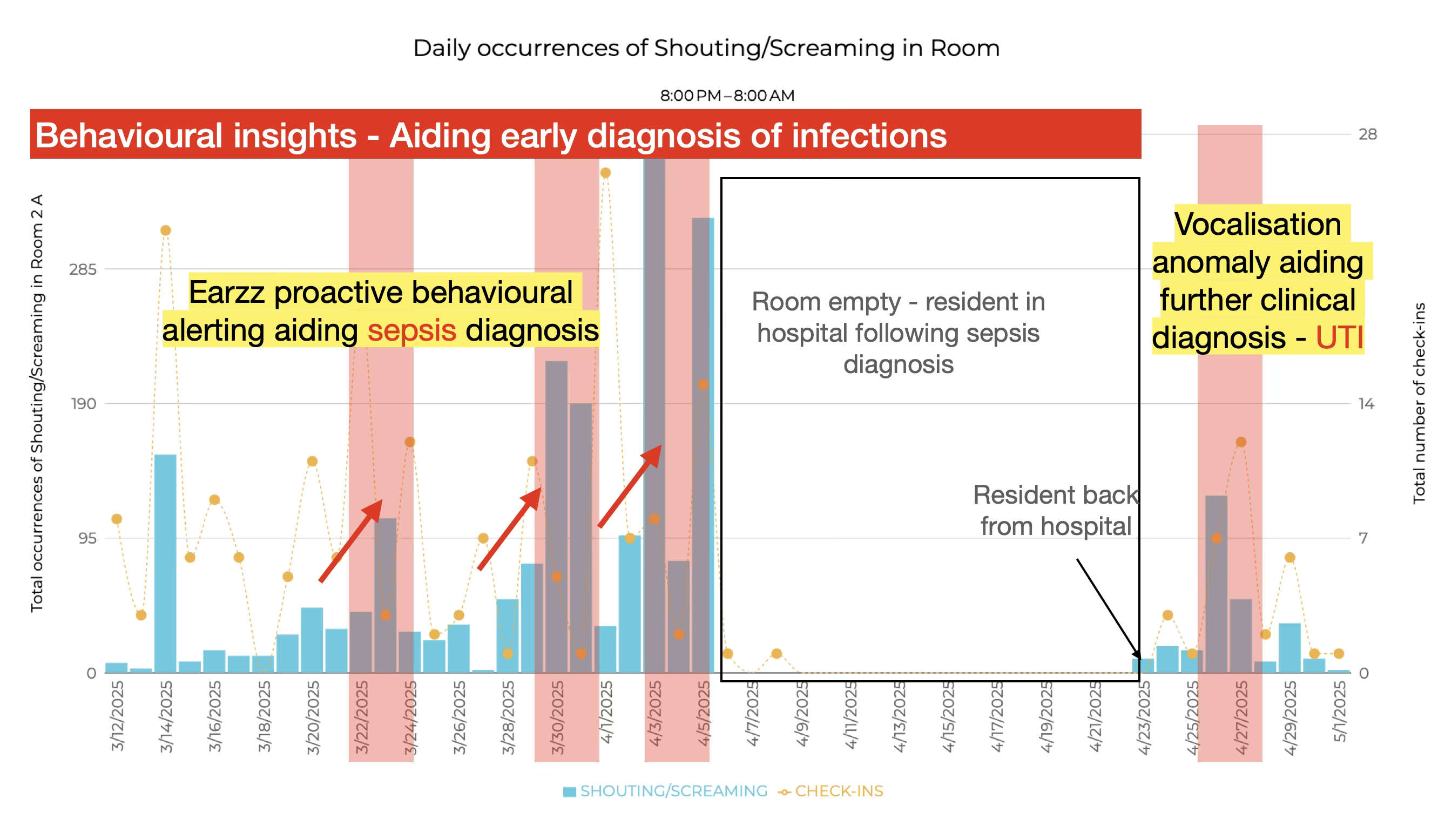
Tracking deviations in behavioural baselines to trigger early intervention
Initial Shift (Leading to April 5th)
Earzz identified rising patterns of nocturnal restlessness and vocalisation. This departure from the baseline prompted the team to contact a doctor early.
Hospitalisation (April 6–22)
The absence of acoustic data confirmed the hospital stay, with monitoring resuming immediately upon return to establish a new post-discharge baseline.
Secondary Spike (April 26th)
Within 72 hours of return, Earzz detected a notably restless night. This objective flag prompted assessment before symptoms were physically visible.
Intelligence Beyond Falls Management
A New Care Paradigm
Helping care teams move from reactive (symptom-based) to proactive (behaviour-based) care.
Staff Empowerment
Earzz provides care teams with objective acoustic evidence, giving them the confidence and data needed to justify clinical escalations.
Post-Discharge Safety
The system provides an intelligent monitoring solution especially for high-vulnerability periods, ensuring non-verbal residents have a "voice" during recovery.
The Key Takeaway
Earzz provides continuous behavioural oversight. By identifying shifts in a resident’s acoustic baseline, the AI provides insights and early alerts that can help proactive care.


